
The Politics of How We See AI: What Metaphors Reveal About Trust, Voting and Governance
Artificial Intelligence is becoming political before most political parties have decided what their politics of AI should be. In a new book chapter, INPLP member Dr Gege Gatt and his co-authors examine how the metaphors people use to make sense of AI intersect with political identity and voting behaviour. A survey of 409 adults in Malta shows that around one third of respondents could not meaningfully define AI at all.
Article provided by INPLP member: Gege Gatt (Mitla Smart City Malta, Malta)
Artificial Intelligence is becoming political before most political parties have decided what their politics of AI should be. In a new book chapter, INPLP member Dr Gege Gatt and his co-authors Rev. Dr Joseph Borg and Prof. Mary Anne Lauri examine how the metaphors people use to make sense of AI intersect with political identity and voting behaviour. A survey of 409 adults in Malta shows that around one third of respondents could not meaningfully define AI at all. This summary is based on Dr Gatt’s own adaptation of the chapter; the full text, including the interactive charts, is available in the original article.
Representation comes before regulation
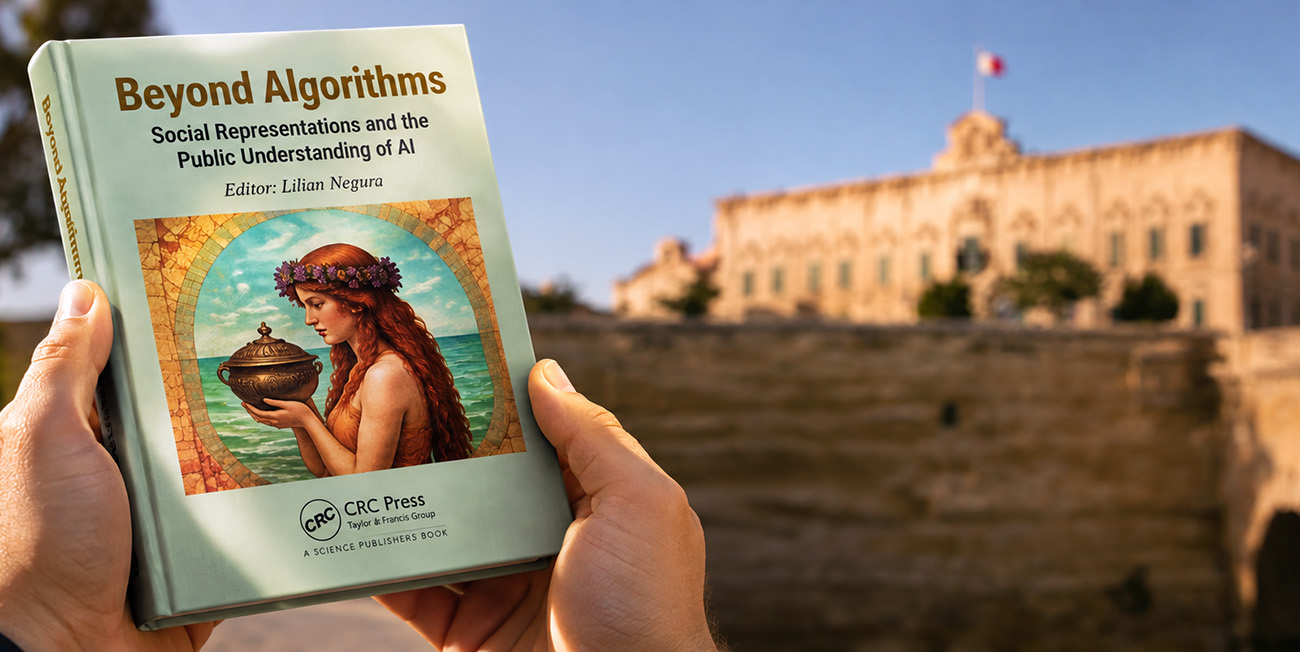
The chapter appears in Beyond Algorithms: Social Representations and the Public Understanding of AI, edited by Prof. Lilian Negura (CRC Press / Taylor & Francis). It builds on Serge Moscovici’s Social Representations Theory. People do not absorb technical knowledge intact. They translate it into familiar images: AI as an assistant, a brain, a servant, a threat. These metaphors carry moral and emotional weight before the technology itself is understood.
Five ways of seeing AI
Respondents were asked to define AI in their own words. Five social representations emerged:
- AI as a helper or assistant (31%)
- AI as a stabilising force (14%)
- AI as a threat to humanity (12%)
- AI as a progressive tool (3%)
- AI as “the unknown” (32%)
The link to voting behaviour
The authors compared these representations with declared votes in Malta’s 2024 European Parliament election. The relationship was statistically significant, but it is an association, not a causal mechanism.
- Voters of the Partit Laburista were positioned closer to AI as a threat and, in particular, AI as the unknown.
- Voters of the Partit Nazzjonalista did not cluster around any single representation, which the authors call “representational ambiguity”.
- Non-voters were closest to AI as a stabilising force, a finding the authors treat with caution.
The authors stress that the evidence does not support the claim that one party is optimistic about AI and another pessimistic. The correspondence analysis behind these findings is shown in the original article.
Beyond material exposure
The findings extend Julian Jacobs’ model of AI-induced political polarisation. Jacobs links political responses to how exposed people are to automation. The chapter adds that these responses are also mediated by the meanings people attach to technology. A view on AI is often a view on institutions, fairness, authority and the future.
The most dangerous representation may be none at all
Fear can be debated and optimism can be challenged. Uncertainty leaves a vacuum. A citizen who cannot explain what AI is depends on someone else’s narrative, and that narrative increasingly arrives through algorithmically curated systems. AI is becoming both the subject of public debate and part of the infrastructure through which that debate takes place.
Why AI literacy is not enough
Knowing how to prompt a system is not the same as understanding its place in society. The authors argue for something closer to citizen literacy: who benefits from a use of AI, who carries the risk, who is accountable for an automated decision, and which decisions should remain meaningfully human. If shared understanding is shallow or absent, democratic control over technology weakens even where regulation formally exists.
Practical Takeaways
- Metaphors shape acceptance: How an organisation describes its AI system (“assistant”, “automation”, “decision-maker”) influences how users and the public judge it. Choose the language deliberately.
- Expect a large “unknown” group: Roughly one in three respondents had no working concept of AI. Transparency notices and explanations should not assume prior understanding.
- Literacy is more than tool training: Programmes that only teach how to use AI tools miss questions of bias, model limitations, data governance and accountability.
- Regulation needs shared understanding: Formal rules do not secure public trust on their own. Where people cannot interpret a technology, others will supply the narrative.
- Read the data carefully: The study shows an association between AI representations and voting in one country. It does not show that views on AI determine votes.
Read the original article: The politics of how we see AI – gegegatt.com